|
||
| Bali tiger | Has the darkest color and smallest size, found in Bali, Indonesia before its extinction. | |
| Caspain tiger | Used to be found in North African, North Iran, East Mongolia, East Turkey and Central Russia. | |
| Indo-chinese tiger | Has lesser pattern than Sumatran tiger with medium color tone, can be found in Myanmar, South China (Cambodia, Laos, Malay Peninsular and Thailand.) | |
| Javan tiger | Found in Java, Indonesia before its extinction. | |
| Bengal tiger | The most common species, found in Bangladesh, Bhutan, Northwest Myanmar, India, Nepal and Thailand. | |
| Siberian tiger | Has the largest size, with thick hair and lighter color. | |
| South china tiger | Has the least pattern and found in Central and East China. | |
| Sumatran tiger | Has the darkest color and smallest size, it can be found in Sumatra, Indonesia. | |

|
||
|
Boundary Indication Behavior
|
||
|
Tiger usually indicates its boundary by scratching on the
trees or spout its urine. Naturally, tiger is not a sociable
animal. It will live and hunt for food within its boundary,
and know about any intruder from the smell. Tiger usually
avoid confrontation and fighting. Furthermore, urine of a
tigress can tell whether it is estrous.
|
||
|
Mating Behavior
|
||
|
During mating season, tiger will live in pairs. The tigress
will cry out from time to time during this period. While the
male tiger will start to look for its mate from urine smell and
show its interest towards the tigress by sniffing its sexual
organ. It will observe the response of the tigress whether it
has conceded, the male tiger then overlie and mate with it. As
soon as they finished mating, the tigress might attack its mate
by the side.
|
||
|
Rearing Behavior
|
||
|
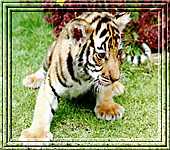
The tigress will give birth after carrying its babies for
95-105 days, and will lick away the mucus until the babies get
clean. This helps to stimulate the circulation system of the
baby tiger. They are fed by their mother's milk. During the
first 7-10 days, their eyes are still closed. The cubs are
trained to eat meat at 2 months old and wean at 5 months old.
During the first two months, the tigress needs to hunt for food
and return to its babies within 24 hours, as the babies cannot
go for hunting together. A cub learns from its mother for 2
years before it starts hunting alone.
|
||
|
Hunting Behavior
|
||
|
Tiger usually hunts for food only when it is hungry. A forest
with highly populated herbivores will have a high population of
tiger. This is an ecosystem. Tiger will hunt for smaller victim
for lower risk
|
||
|
Four hunting procedures
|
||
|
||
|
Tiger usually bite at the victims' neck but does not prefer
biting from the back as most of its victims are animals with
horn such as deer. After hunting a victim, tiger will eat the
hip part first. If it cannot finish its food, it will conceal
the food or let other tiger eat it.
|
||
|
Changing Behavior
|
||
|
Tiger prefers to live alone but when they are put together, they will fight to be the leader. If there are two crowds living in the same area, they will fight with one another. Tiger's hunting behavior will reduce under human care. But when they are stimulated to hunt, they will hunt by their instinct.
|
||
| Bengal tiger | |
|
Tiger
|
Panthera tigris Linnaeus, 1758 |
|
Dispersion of population
|
In Siberia, Caspian, India, Southeast Asia, Sumatra, Java and Bali. |
|
Characteristics
|
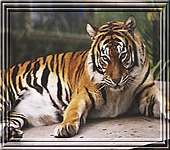
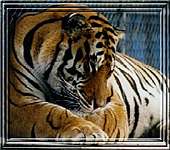
Tiger is the largest in its entire species. Its body is brownish yellow or grayish yellow. Each tiger has different patterns of black strips on its back and side. The hairs on its stomach, chin, neck and above the eyes are white and have black stripes. There is no black tiger but there is white tiger in India. A big male tiger can weight more than 300 kilograms. |
|
Ecology and Behavior
|
Tiger likes to live near water source or shady place. It does not like warm weather and usually lives in thick, cool forest and rest during the daytime. It likes to swim especially in a warm day; it can spend hours in the stream. Tiger looks for its prey in the evening and it can eat everything from fish, tortoise, porcupine or even tiger. It likes to hunt for wild pig and deer for food. It will chase its victim about 10-20 meters, then pounce upon it from the back or side. Tiger will start to eat its prey at the hip part. It needs about 6-7 kilograms of food per day, some even take up to 25 kilograms. If the older or sick tiger has eaten human, it will want to eat again. However, tiger naturally does not like to come near human. Tiger likes to live alone, it can never be found living in pair. A group of tigers that can be found is usually the mother tiger and its cubs. During mating season, the tigress often growls loudly. A tigress carries its baby for 100-108 days and gives 1-3 babies per time. The tigress normally looks after its cubs for 2 years. The female cub usually stays with its mother longer than a male cub. |
|
|

Sriracha Tiger Zoo
341 Moo3, Nongkham. Sriracha, Chonburi 20110 THAILAND
Tel : +66(0)3829 6556-8, 296 571-2 Fax : +66(0)3829 6559
Bangkok Office
Dynasty Building Complex, 67/11 Soi Ladprao 71,WangthongIang,
Bangkapi, Bangkok 10240 THAILAND
Tel: +66(0)2933 0566,
933 0977 Fax: +66(0)2933 0311
 [email protected]
© Copyright 2000,Thailand, Sriracha Tiger Zoo,
www.tigerzoo.com